Singapore International Foundation Champions Climate Adaptation at Climate Conference
It highlights the criticality of its multi-stakeholder platform to address water challenges in Southeast Asia through innovative climate adaptation efforts.

The Singapore International Foundation (SIF) joined policymakers, activists, businesses, and climate experts at the 29th UN climate change conference (COP29), at which it highlighted the Southeast Asia Partnership on Adaptation through Water (SEAPAW) and its efforts towards enhancing water resilience.
COP29, which was held in Baku, Azerbaijan, was themed “In Solidarity for a Green World”. It aimed to set ambitions and responsibilities, identify and assess measures, and develop solutions that address climate change. This year’s conference focused on efforts to mobilise financial support for developing nations to reduce greenhouse gas emissions and build resilience to climate-related catastrophes.
It also highlighted the critical role of water in climate action, calling for integrated approaches to protect water basins and ecosystems. The conference introduced the Baku Dialogue on Water for Climate Action, a framework to ensure ongoing collaboration and coherence in water-related climate strategies.
At a panel discussion held at the Singapore Pavillion on Food, Agriculture and Water Day, SIF CEO Ms Corinna Chan and SEAPAW Chairperson Professor Khoo Teng Chye introduced SEAPAW to conference participants.
The multi-stakeholder platform was launched in June 2024, in collaboration with the World Economic Forum, to drive climate resilience in the region. It aims to unite stakeholders across borders and sectors, foster projects that address water-related challenges, and accelerate adaptation financing through public-private-philanthropic models.
Driving Climate Adaptation Through Water
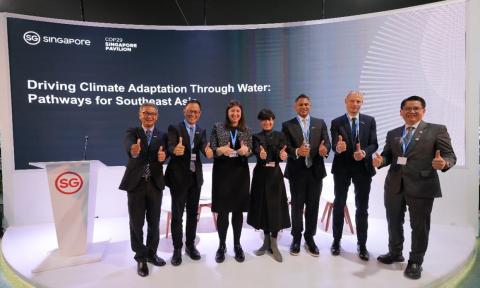
Titled Driving Climate Adaptation Through Water: Pathways for Southeast Asia, the discussion focused on innovative water-centric solutions tailored to a region particularly vulnerable to climate impacts.
Mr Stanley Loh, Permanent Secretary at Singapore’s Ministry of Sustainability and the Environment, who spoke at the event, highlighted SEAPAW’s role as a bridge between government-led and community-driven approaches.
He said: “Climate change has a close nexus with water, impacting its distribution and leading to extreme floods, rising sea levels, and prolonged droughts. SEAPAW exemplifies how we can localise global solutions, harness innovation to address these challenges and meet the unique needs of Southeast Asia’s communities. Through collective efforts, we can enhance resilience and secure a sustainable future for all.”
The panel featured:
Moderator: Mr Michael Toh, Director, Industry & Technology Collaboration Department, PUB, Singapore's National Water Agency
Dr Virginia Newton-Lewis, Water Sustainability Director, Grundfos
Ms Corinna Chan, CEO, Singapore International Foundation
Mr Dave Sivaprasad, Managing Director & Partner, Climate & Sustainability Lead, Southeast Asia, Boston Consulting Group
Dr Henk Ovink, Executive Director, Global Commission on the Economics of Water
The discussion underscored critical strategies that address climate adaptation through water resilience. Ms Chan highlighted SEAPAW’s role to address water resilience challenges across Southeast Asia and emphasised how it encourages conversations and collaboration to develop impactful projects that enhance climate resilience in the region.
She said: “SEAPAW is committed to foster collaborative, ground-up solutions to address Southeast Asia’s pressing water resilience challenges. By tailoring approaches to local contexts and leveraging cross-sector partnerships, we aim to deliver scalable and impactful outcomes that truly meet the needs of communities.”
The panel advocated holistic water governance, innovative financing, and mobilising diverse capital sources. They called for policies and business models to scale water resilience solutions. They emphasised the need to revalue water resources and prioritise community-based adaptation approaches. Discussions also highlighted the importance of effort integration across sectors to ensure transparency and value creation within supply chains.
The session concluded with a call to action:
Collaborate – Unite policies, expertise, and resources across countries and sectors to tackle climate adaptation challenges.
Act – Build on the momentum and implement tangible projects to drive meaningful change.
SEAPAW’s Vision and Announcements
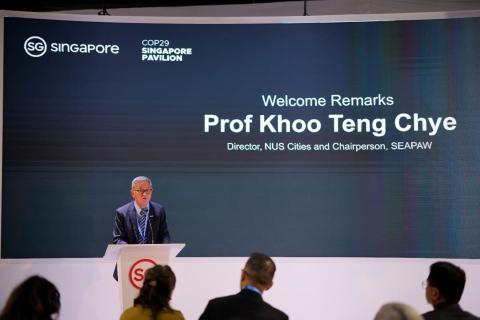
During the session, Professor Khoo Teng Chye, Chairperson of SEAPAW, shared key updates on the initiative’s progress since its launch. He stressed that cross-border partnerships are essential to address Southeast Asia’s water challenges and outlined SEAPAW’s projects:
Clean Water Access for Rural Communities in Sarawak: This pilot introduces renewable energy-powered water purification systems to underserved areas in Sarawak, Malaysia, to support the state’s Post-COVID Development Strategy 2030 goal to achieve 100% water supply coverage.
Sustainable Agriculture for Food Security and Farmer Livelihoods: This project will introduce sustainable practices in rice cultivation and explore opportunities for carbon credit certification to improve food security and enhance livelihoods for smallholder farmers.
Research on Coastal Resilience in Southeast Asia: This research project will address critical gaps in data on coastal resilience in the region. It seeks to strengthen policy and infrastructure to protect coastal communities from climate vulnerabilities.
Position Paper on Water Adaptation in Southeast Asia: Developed in collaboration with the World Economic Forum, this paper aims to define water-centric climate resilience frameworks and outline sustainable adaptation practices.
Looking Ahead
Since its inception, SEAPAW has brought together 20 global and regional member organisations to foster collaboration among industry leaders, policymakers, and knowledge partners. At COP29, SIF reaffirmed its commitment to leverage these partnerships to drive innovative, scalable solutions for water sustainability and climate resilience in Southeast Asia.
Organisations interested to collaborate with SEAPAW may visit its webpage or contact [email protected].
This Might Also Interest You