Youth at the Forefront of Sustainability: A Learning Journey
How can the youth contribute to the global effort to battle climate change?
This article is authored by Ms Sheena Joy Palcis, co-founder of E-Connect, one of the winning teams of Climate Hack 2024.
Rising temperatures around the world, termed ‘global boiling’, have long occupied news headlines. Alongside this alarming heat, the world continues to grapple with other pressing issues such as rising sea levels and biodiversity loss. At the same time, Artificial Intelligence (AI), now deeply embedded in daily life, offers new opportunities to tackle these global challenges and strengthen climate resilience. This intersection of technology and climate action drew me to the Singapore International Foundation’s (SIF) Climate Hack, a five-month program designed to empower young innovators to build their own digital climate solutions.
Building on my experience in climate advocacy, Climate Hack helped me to move from theory to practice. Through technical skills workshops such as app development and entrepreneurship, I was able to build an app to raise awareness on greenwashing and eco-conscious products. The mentorship from industry experts across disciplines also provided invaluable insights into driving meaningful, scalable change.
During the programme, participants formed teams and developed climate solutions that we subsequently presented at Pitch Day. My team and I identified a pressing need — many climate startups and project owners face barriers in accessing funding and technical support. This led us to create E-Connect, an AI-powered platform designed to connect climate innovators with the resources they need to thrive. Through E-Connect, we hope to support and amplify collective efforts to address climate change amid an ever-evolving global landscape.
Collaborating with a diverse, multicultural team was a key highlight. With team members from Indonesia, Malaysia, Pakistan and the Philippines, our shared commitment to climate action allowed us to combine unique strengths and incorporate best practices from our respective countries. This experience taught us to navigate challenges and bridge gaps as a team, and refine our approach based on advice from our mentors, ultimately leading to a robust and sustainable solution. Our teamwork and dedication were rewarded when E-Connect was selected as one of the winning solutions at Climate Hack, granting us a fully funded Learning Journey in Singapore.
This experience was deeply enlightening. Singapore’s commitment to sustainability is evident – not only does it rank 7th in the Global Destination Sustainability Index (2023), the Singapore Green Plan 2030 sets clear targets, including achieving net-zero emissions by 2050. In the Philippines, sustainability efforts are already underway, particularly in waste management, agriculture, and renewable energy. However, the innovations and approaches observed in Singapore, driven by its national commitment to an inclusive green future, offer inspiration on how we might scale and strengthen these efforts.

Waste Management
Efforts to reduce single-use plastics in the Philippines have gained traction through policy and community initiatives. I believe these efforts can be further enhanced through social advocacy and youth empowerment. Singapore’s Green Nudge – a sustainability consultancy – demonstrated how creative social media strategies can help keep the public engaged and educated on the harms of single-use plastics. At the same time, they encourage greater climate action among youths, whether at local clean ups or through waste segregation at large scale events such as the Coldplay concert held in January. Similar youth-led initiatives in the Philippines could adopt such strategies to encourage deeper grassroots engagement.
Agriculture
Despite being a major rice exporter, the Philippines faces persistent challenges like inflation and limited access to smart farming technologies. These issues disproportionately affect small-scale farmers, deepening inequities within the industry and hindering their ability to compete and thrive. In Singapore, we saw how the country’s first commercial rooftop farm ComCrop and social sustainability initiative TinkerThings Global have implemented urban farming and regenerative practices such as vermicomposting efficiently. These models offer valuable insights into how tech-driven solutions can be adapted to the Philippine context to improve food security while promoting inclusivity and empowering marginalised farming communities.
Renewable Energy
While the Philippines has invested in solar and wind energy, scaling adoption – particularly within the private sector – remains a challenge. During the Learning Journey, we visited Razer Inc., a Singaporean gaming company that powers its Southeast Asia Headquarters with solar energy. This demonstrated how corporate adoption of renewable technologies can be both feasible and impactful. Razer’s commitment serves as a compelling case study, highlighting the potential for similar initiatives in the Philippines. By fostering strong public-private partnerships, we can encourage more companies to integrate renewable energy into their operations and accelerate the country’s transition to a sustainable energy-driven future.
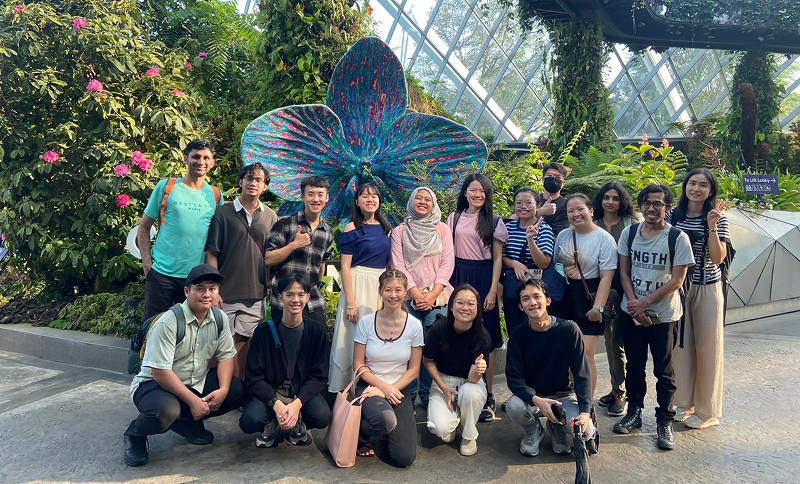
Our Carbon and Climate Tour in Singapore’s Gardens by the Bay also demonstrated how sustainable technologies – from electric transport to biomass fuel – can co-exist with public education and tourism. This blend of awareness and innovation is a powerful formula that could inspire similar initiatives back home.
The Learning Journey strengthened my team’s commitment to further refine our climate solution and to go beyond advocacy to be solution-builders. I urge youths across the world to play your part in building a more sustainable future too.
Start by identifying climate challenges in your community and join local organisations to help address them. Learn from successful practices abroad and seek out platforms such as Climate Hack that support turning ideas into action. You can also follow developments by the Southeast Asia Partnership for Adaptation through Water (SEAPAW), which was launched by the SIF and the World Economic Forum in June 2024. SEAPAW brings together diverse stakeholders to share knowledge and pool resources to address water-related challenges driven by climate change. One of its pilot projects is the Clean Water Access for Rural Communities which aims to deliver sustainable, clean water access to rural communities in Sarawak, Malaysia. Other remarkable initiatives include supporting sustainable agriculture, coastal resilience research, and policy advocacy on water adaptation in Southeast Asia.
Meaningful change begins with small steps that are within your reach. Now more than ever, it is time to stay engaged, be inspired, and take action. Our collective efforts today will shape the world of tomorrow.
Sheena Joy Palcis is a medical student at Matias H. Aznar Memorial College, Inc., Cebu City and a physical therapist with a Bachelor’s degree from Silliman University, Dumaguete City. A passionate health and climate advocate, she served twice as Editor-in-Chief of her college publication focusing on climate issues, and represented it at the College Press Conference and Awards of the Philippine Information Agency. She also currently serves as Network Deputy of the Standing Committee on Medical Education (SCOME) of the Asian Medical Students’ Association (AMSA) — Philippines, Health Sciences Editor of Juan Health PH, and Managing Editor of the Journal of Asian Medical Students’ Association (JAMSA) — International.
As a youth leader, Sheena was one of 27 delegates at the EmpowerASEAN: Youth Leadership Programme in the ASEAN Region organised by the United Nations Institute for Training and Research (UNITAR) and Indonesian Youth Diplomacy (IYD). As part of the programme, her group championed the “East Timor Digital Literacy Initiative”, contributing to UN SDG 4 (Quality Education). She was also the Philippines Country Informant for the Asia-Europe Foundation’s Science and Technology Diplomacy Report, where she presented her findings at the Asia-Europe Young Researchers Seminar and represented her country at the World Science Forum 2024. Most recently, she delivered a speech at the United Nations Economic and Social Council (ECOSOC) Youth Forum 2025, advocating for the youth to be placed at the heart of global partnerships (SDG 17). Connect with her on LinkedIn.
This Might Also Interest You