Working for Social Good
The SIF’s two-year partnership with the University of Labour and Social Affairs (ULSA) will impact over 1,000 social work students to uplift the quality of social work teaching and practice in Vietnam.
A complex and multi-faceted sector, social work comprises various areas such as working with families, drug abusers or people with disabilities, intervening in family violence and promoting community development. All these topics and more were covered in training workshops spanning two years, during which Singapore specialist volunteers trained 40 Vietnamese social work teachers and practitioners to uplift the quality of teaching and practice in the country.
“Social workers do not work in a specific field. We help people to access services,” said Mr John Ang, Singapore International Volunteer and Senior Fellow at the Department of Social Work in the National University of Singapore (NUS). “We are in the business of getting people to continue lifelong learning. That’s the business of social work.”
A relatively new sector in Vietnam, social work was officially recognised as a formal profession in the country as recent as May 2010.
From 2010 to 2012, a team of seven Singapore specialist volunteers comprising veterans in the governmental, academic and practicing aspects of the social work sector and led by John conducted six training workshops in Vietnam and two training attachments in Singapore for Vietnamese trainees. The project enabled the exchange and transfer of knowledge between Singaporean and Vietnamese professionals, as well as between Vietnamese academics and practitioners, in order to result in an overall reinforced understanding of the social work discipline and profession.
After the project ended, social work academics and ground practitioners reported that they were working more closely together and exchanging notes between themselves, closing the gap between practice and theory and creating a greater collective understanding of social work in its entirety.
The project also sought to enhance the teaching and curriculum development skills of the ULSA staff to drive a higher standard of social work teaching. The impact of training 40 Vietnamese social work professionals is expected to cascade down to over 1,000 social work students from Vietnamese universities, as well as the communities they work with.
The training project was a two-way learning journey for the Vietnamese and Singaporean participants, introducing both to each other’s cultures, working styles and practices. Said John, “All the volunteers found the experience both enriching and challenging. We formed close working relationships with the participants that were further augmented through outside training correspondences and the two attachments in Singapore. This facilitated learning from both sides that enriched the teaching of students in both countries.”
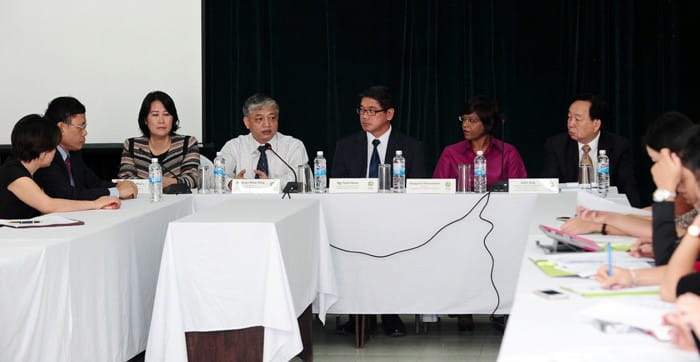
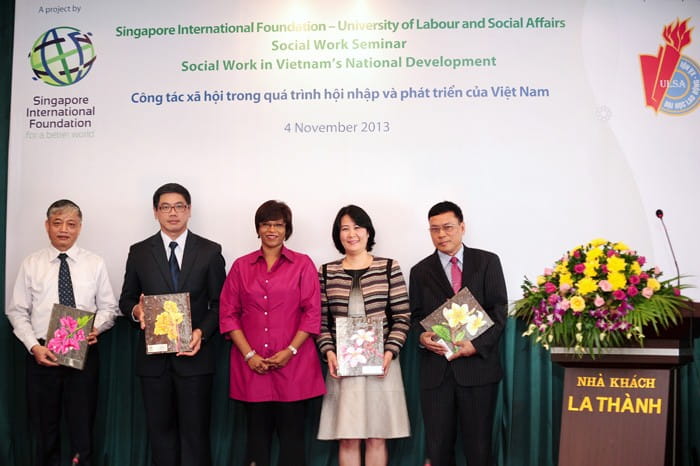
As a culmination of the two years of cross-cultural learning and collaboration, a one-day social work seminar was organised at La Thanh Hotel in Hanoi, Vietnam, which was oversubscribed and saw more than 100 Vietnamese academics, practitioners and students come together in a shared national cause of addressing social challenges by enhancing and recognising the social work profession in the country.
The seminar was attended by Singapore and Vietnamese partners and beneficiaries, including Vice Minister, Ministry of Labour, Invalids and Social Affairs (MOLISA), Dr Doan Mau Diep, Senior Expert, Ministry of Education and Training (MOET), Mr Nguyen Khac Binh, Rector, ULSA, Professor Nguyen Thi Thuan and Singapore Ambassador to the Socialist Republic of Vietnam, His Excellency Ng Teck Hean.
Said Professor Nguyen Thi Thuan from ULSA, “Our partnership with SIF has helped to enhance the quality of teaching for our social work department, and improve the knowledge and confidence of our lecturers. Through this project, it is our hope that social work, which is a fairly new discipline and profession, will be more affirmed and legitimised in Vietnam.”
These impressions of the SIF-ULSA Social Work Seminar in Hanoi were contributed by SIF staffer Charlene Poon.
This Might Also Interest You