Good Business Cents
To achieve a higher purpose, business leaders need to be conscious capitalists, in a paradigm shift from profit-maximisation to purpose-maximisation.
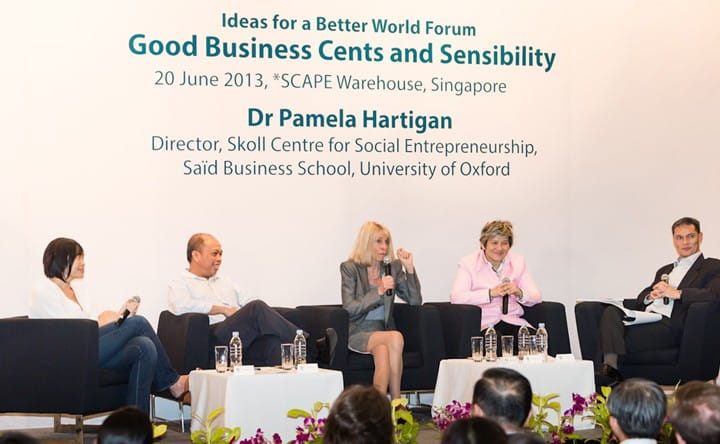
Keynote speaker, Dr Pamela Hartigan, won the audience over at the Singapore International Foundation’s 11th Ideas for a Better World Forum on 20 June 2013, when she confided to them that Singapore is her favourite Asian city.
The world leading proponent of social entrepreneurship, who is director of Skoll Centre for Social Entrepreneurship at University of Oxford’s Saïd Business School, spoke candidly on the theme of “Good Business Cents and Sensibility.”
She spoke about how “entrepreneuring” is different from being an “entrepreneur.” Only some can be entrepreneurs but “entrepreneuring” is something she believes everyone can do, including governments, the commercial sector and charities. Her belief is that what will create positive social change through markets is a mind shift and she emphasised that to achieve a higher purpose, business leaders need to be conscious capitalists, in a paradigm shift from profit-maximisation to purpose-maximisation.
Drawing on her extensive experience in corporate citizenship, public health, development and private/public partnerships, Dr Hartigan suggested that social entrepreneurship, as an approach rather than a specialised field, could pave the way toward a transformation of capitalism.
At the forum held at the *SCAPE Warehouse, Dr Hartigan was joined by key players in the social enterprise landscape in Singapore for the discussion that followed. The panellists were Elim Chew, Governor of SIF and founder of 77th Street, Alfie Othman, executive director of the Social Enterprise Association and Kuik Shiao-Yin, co-founder and creative director of The Thought Collective. They spoke of how business leaders need to be mindful of the short and long term consequences of their actions and to act as “conscious capitalists.” The need for a shift from the mentality of profit-maximisation was summed up by Othman, who said, “If you can block out the part of the human mind that focuses on making as much money as possible, it can focus on creating value and being sustainable.”
This Might Also Interest You